How to Choose a Water Dispenser for a Small Office
Choose a water dispenser for a small office by deciding who will change the jugs, who will clean it and where it will sit. Then match the type to how many people share it, whether a water line can reach the spot, and the hot water safety your break room needs.
On this page (12 sections)
- Who will use the dispenser, and how often?
- Jug or bottleless: which fits your office?
- Which loading style suits a break room?
- What cleaning routine does a shared break room need?
- Where should the dispenser go?
- What should you check about the hot spout?
- What affects the power an office unit uses?
- Should one unit serve the whole office?
- What happens when a jug runs out?
- Which warranty should an office check?
- Checklist before you order an office dispenser
- Pick the right water dispenser for a small office
A water dispenser for a small office is a shared appliance, so the right choice depends on how people use it and who keeps it running. This guide works through those decisions in the order most offices meet them.
Water cooler vs water dispenser explains the terms if the two names confuse you.
This guide is for people who buy a unit for the office. If you are shopping for a home, best hot and cold water dispensers for home and our water dispenser buying guide for home cover that case.
We compared the specs and features that brands publish for four models: three from Brio and one from Avalon. Each section starts with the decision, then shows the model that fits it.
Who will use the dispenser, and how often?
Start with how many people share it and how often they fill a cup, not with a capacity number. Those two facts tell you how often a jug runs out or a filter needs changing.
How a water dispenser gets used in a small office
Write down how many people use the break room each day and when the rush hits, such as mid-morning. A few extra people on a busy day can change how often a jug runs out.
Hot drinks draw from the same jug, so count tea and coffee cups along with glasses of cold water.
What a 5 gallon jug covers
A 5 gallon jug holds about 80 eight-ounce glasses. Divide 80 by the glasses your team pours in a day to see how often a jug changes.
| Glasses poured per day | A 5 gallon jug lasts about |
|---|---|
| 10 | 8 days |
| 20 | 4 days |
| 40 | 2 days |
| 80 | 1 day |
A 3 gallon jug holds about 48 glasses, so it runs out sooner. Treat these numbers as a rough guide, since real use swings from day to day.
Decide who refills it before it arrives
Decide who orders the jugs and who swaps them before the unit comes in. Shared tasks slip easily, and an empty dispenser gets noticed fast, so one named person is the safest plan.
Water weighs about 8.3 pounds per gallon, so a full 5 gallon jug is over 40 pounds. Choose a person who can lift that, and decide where spare jugs will wait so they stay out of the walkway.
Jug or bottleless: which fits your office?
A jug unit fits an office that can plan bottle swaps, and a bottleless unit fits a break room with a water line nearby. If no water line can reach the room, a jug unit is the practical choice.
Jug units need a bottle routine
Jug units take bottles that someone has to carry, connect and swap. The Brio 130 Series and Brio 520 Series are built for 5 gallon bottles, while the Brio Essential takes either a 3 or 5 gallon bottle.
Brio says the 130 Series needs no tools, plumbing or water line for immediate setup.
The unit is corded electric, so it needs an outlet within reach, and a full jug needs room to slide in.
Bottleless units need a line and filters
The Avalon bottleless unit comes with an installation kit that includes 20 feet of 1/4-inch tubing and an under-sink adapter with a shut-off valve.
Follow the maker's install guide for the hookup, and if you lease the space, check with your landlord first.
Avalon gives the filter life as 6 months or 1500 gallons. That works out to a bit more than 8 gallons a day, so a busy office could reach the gallon limit first.
Avalon says the filter is NSF certified and the unit is UL listed, and it adds a replace-filter indicator light.
Give filter changes to the same person who handles cleaning, so the task has one owner.
Which loading style suits a break room?
Bottom loading suits a break room where the jug can sit in a base cabinet. Top loading suits a room where the person changing jugs can lift them comfortably.
Bottom-loading water dispensers explains how this type works, and best bottom-loading water dispensers compares more models if you want a wider set.
Bottom loading keeps the jug out of the way
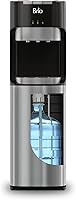
The Brio Essential is a bottom-loading unit with hot, room-temperature and cold spouts. Brio says its cabinet fits either a 3 or 5 gallon jug, and an LED display alerts you when the bottle needs replacing.
Keep the unit where the jug can slide in without blocking a door or a cabinet that people open all day.
Top loading needs a clear lifter
Top loading puts each full jug on the top of the unit. That works when the person changing jugs can lift 40 pounds or more comfortably, so name that person before you choose top loading.
All four models in this guide are bottom loaders or bottleless. Top-loading vs bottom-loading water dispensers compares the two styles if you want to weigh them.
What cleaning routine does a shared break room need?
Give cleaning one owner, follow the maker's manual and keep to a routine the office will actually keep. Self-cleaning helps with one part of that routine, but it doesn't replace the rest.
Assign one owner and a backup
One person should own cleaning, filter changes and jug swaps, with a backup for holidays and sick days. A written schedule on the unit or in the office task list keeps the job from falling between people.
A sign-off sheet with a date and initials for each cleaning shows at a glance when the last one happened.
Self-cleaning is one step, not the whole job
Brio says the 520 Series has a UV self-cleaning feature that starts with one button press. Avalon lists a self-cleaning feature on its bottleless unit too, so read each manual before you assume the same routine applies.
Schedule the manual's cleaning steps alongside the self-cleaning feature, so the office doesn't rely on one step alone.
Start with the manual
Start any cleaning by unplugging the unit, then check your manual for the steps and the cleaners it names. Some manuals allow a cleaning kit or a mild vinegar solution, so use only what yours names.
Rinse well and let the unit dry before you turn it back on.
How often to clean a water dispenser covers timing, and how to clean a water dispenser, step by step walks through the general steps.
Where should the dispenser go?
Place it near an outlet, away from heat, and clear of the walkway so people can reach the spouts without bumping into anyone. A spot with heavy foot traffic is harder to keep clean.
Plan the jug path
A full jug has to travel from the door to the unit, so measure the corners and doors along that route before you choose a spot.
Size at a glance
All four models stand about 41 inches tall, so height fits most break room corners the same way. Depth and weight differ more.
| Model | Height | Depth | Weight | Jug |
|---|---|---|---|---|
| Brio Essential | 41.4 in | 15.6 in | 40.6 lb | 3 or 5 gallon |
| Brio 520 Series | 41.4 in | 15.6 in | 39.6 lb | 5 gallon |
| Brio 130 Series | 41.7 in | 14.4 in | 39.2 lb | 5 gallon |
| Avalon bottleless | 41 in | 14 in | 44 lb | None |
Check the depth against your spot before you order, because a few inches decide whether a corner works.
Keep it away from heat
Keep the unit away from ovens, microwaves and sunny windows, since a warm spot makes the cooling side work harder.
Leave room at the spout
Brio says the 520 Series has an illuminated dispensing area, so people can see what they are pouring. Leave room in front of the unit so people can reach the drip tray area and wipe up spills.
Check the noise near a desk
None of the four makers publishes a noise level for these models. If the unit will sit near a desk or a quiet room, ask the brand before you order.
What should you check about the hot spout?
Hot water can burn, so compare the hot spout features before you choose a model. All four models in this guide list a lock on the hot spout, and the locks differ a little.
Compare the locks on the four models
Brio describes a two-step release on the Essential, the 520 and the 130: you release the lock, then press for hot water. Brio says the hot button relocks after dispensing on the 520 and the 130.
Avalon lists a child safety lock on the hot spout of its bottleless unit.
Know how hot it gets
Brio rates the Essential up to 198 °F and the 520 up to 200 °F. Water that hot can burn, so keep the unit where people have room to stand at the spout.
What affects the power an office unit uses?
Whether the hot side stays on and how often people draw hot water matter most. A hot side that is switched off after hours uses less power, but only on a unit that has a switch for it.
Watts from the brands
Brio gives the 130 Series a 300-watt figure and names ENERGY STAR 3.0 for it. Use brand figures to compare models rather than to predict how much power the office will use.
Check the controls before you buy
We didn't find an after-hours switch named for any of the four models. If one matters to your office, ask the brand whether the model has it.
For the full picture, read how much electricity a hot and cold dispenser uses.
Should one unit serve the whole office?
Decide whether one unit serves the whole office or each team gets its own. Two units mean twice the upkeep, so count that before you buy.
If the office spans several floors, a unit on each floor may save the walk, but it adds another set of jugs or filters to track.
Flow speed matters if a lunch rush forms a line. Brio gives the 130 Series a flow rate of 1.5 liters per minute.
What happens when a jug runs out?
Plan for an empty jug before it happens, with a clear owner and a simple way to report it.
Reorder before the last jug
Reorder when the current jug is about half used, not when it's empty. That gap gives the team time to get a new bottle in before the break room runs dry.
Use the empty-bottle light
Brio lists an empty-bottle alert for the Essential, the 520 and the 130. Show everyone what the light means and who to tell when it comes on.
The Avalon bottleless unit has a replace-filter light instead, so the same rule applies to filters.
Which warranty should an office check?
Check the warranty length before you order, since the four models don't all publish one. Avalon gives its bottleless unit a 1-year warranty.
We didn't find a warranty length for the three Brio models, so ask Brio before you order. A written warranty is easier to rely on when many people share the unit.
Checklist before you order an office dispenser
Work through these checks before you order, so the unit fits the room and the people who will use it.
- Count the daily users and the busy hours.
- Name the person who orders, swaps and cleans, plus a backup.
- Choose jug or bottleless, and confirm a water line if you go bottleless.
- Pick bottom or top loading based on who lifts the jugs.
- Check the outlet, the floor space and the walkway.
- Confirm the hot spout lock and the drip tray area.
- Ask the brand about noise if the unit sits near a desk.
- Check the warranty length.
Pick the right water dispenser for a small office
Pick the Brio Essential if you want a bottom-loading unit with hot, room and cold spouts for a 3 or 5 gallon jug.
- Pick the Brio 520 Series if you want bottom loading and a UV self-cleaning feature you start with one press.
- Pick the Brio 130 Series if no water line can reach the break room and you want a jug unit that needs no plumbing to start.
- Pick the Avalon bottleless unit if a water line can reach the spot and you want to skip jug changes.
For the models side by side, see best hot and cold water dispensers for small offices. If you are also buying for a home, the water dispenser buying guide for home covers that setup.
Frequently asked questions
How many people should a small office water dispenser serve?
There is no fixed headcount that fits every office, so count how many people fill a cup each day and when the busy hours fall. Those two numbers tell you how often a jug runs out or a filter needs changing, which matters more than any single capacity figure.
Is a bottleless water dispenser better for an office?
Not always, because a bottleless unit skips jug swaps but needs a water line near the break room and filter changes on a set schedule. A jug unit fits an office that can plan bottle swaps and has no water line nearby, so pick the type your office can keep running.
Can a small office use a dispenser without a water line?
Yes, if you choose a jug model, and Brio says its 130 Series needs no tools, plumbing or water line for immediate setup. You still need an outlet within reach of the cord, floor space for a full jug and someone who swaps the bottles on time.
Who should clean a water dispenser in a break room?
Name one person to own cleaning, with a backup, and make sure everyone knows who that is. That person unplugs the unit first, follows the maker's manual and uses only the cleaners the manual names, and a sign-off sheet on the unit keeps the task from slipping.
Is hot water a safety concern in a break room?
Hot water can burn, so check whether the hot spout has a lock before you buy. All four models in this guide list a lock on the hot spout, and the unit should sit where people have room to stand at the spout without crowding the walkway.